Toxic Exposure Risk Activity, or TERA, is a VA term that means you may have been exposed to harmful substances in service. This could be something the VA already recognizes, concedes, or that your records show you were exposed to.
Many people think TERA only applies to those who served in Southwest Asia, but that’s not true. TERA can apply to any Veteran, from any time period, if the evidence can establish that you were exposed to toxic substances during service.
Before going further, let’s clear up one big misunderstanding:
Is TERA a presumptive law?
No. TERA is NOT a presumptive law.
If anyone ever tells you to claim a condition as a TERA presumptive, run away. That’s a sign they have no idea what they’re talking about.
Nowhere in TERA regulations does it automatically presume that an illness is due to toxic exposure in service.
Instead, what TERA does is that it requires the VA to determine if you were exposed to toxic exposures in service and it requires VA to get a medical exam and opinion if certain requirements are met. If that medical opinion shows your condition is linked to your in-service toxic exposure, then the VA can grant service connection.
There are instances where VA may presume that you were exposed to certain toxins, but service-connection still requires a medical nexus.
In short, TERA is a form of direct service connection. You still need a doctor’s opinion (called a medical nexus) that links your illness to the toxic exposure you had during service.
Let me repeat that: The VA might agree that you were exposed to something harmful, but that doesn’t mean they automatically agree that your illness was caused by that exposure.
This is where the confusion often starts, because some of the exposures conceded under presumptive laws are automatically considered a type of TERA.
Let’s look at a few examples.
Example: Burn Pits and other Toxins (BPOT) (PACT Act)
Under the PACT Act, 38 U.S.C. 1119 presumes that Veterans who served in Southwest Asia were exposed to burn pits and other toxins (BPOT). This law also includes a list of presumptive disabilities: these are the illnesses that the VA automatically connects to that exposure.
But what if your illness is not on the presumptive list?
Is it an automatic denial? No.
This is where TERA steps in.
The VA will still agree that you were exposed to burn pits or other toxins (BPOT), but, since they can’t presume that your disability is caused by this exposure, they are obligated to order a medical exam and opinion to see if your illness is caused by that exposure.
Example: Vietnam Era Veterans and herbicide exposure
The same idea applies to Vietnam Veterans who were exposed to herbicides (i.e. Agent Orange). If you had “boots-on-the-ground” service in Vietnam during certain dates, the VA automatically presumes exposure. That exposure comes with its own list of herbicide presumptive illnesses.
But what if you also worked on a ship that used asbestos? Unlike herbicide exposure, asbestos exposure has no list of presumptive illnesses.
Under TERA, if your disability isn’t on the list of disabilities presumed to be caused by herbicides, the VA still has to request a medical opinion to see if your condition is linked to herbicide exposure or to asbestos exposure, including the combined, synergistic effects of both herbicides and asbestos.
TERA is a form of direct service connection
TERA doesn’t automatically connect your illness to your service.
But it does give VA another way to potentially connect disabilities that are not presumed to be caused by toxic exposures.
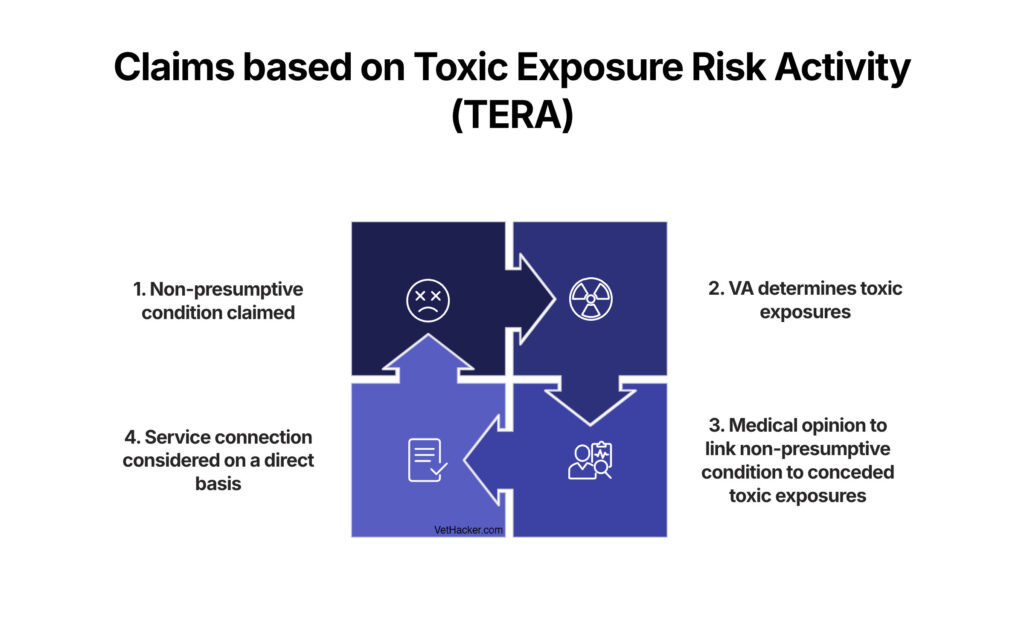
What does TERA actually change in VA Law?
When most people talk about the PACT Act, they focus on the new presumptive conditions for Gulf War veterans – the long list of illnesses that VA now automatically connects to toxic exposure.
But the TERA regulations are just as important – maybe even more so.
TERA changes how the VA decides when to order a medical exam and opinion for your claim.
For non-TERA claims, VA regulations require that the evidence show three elements before VA will request a medical examination and medical opinion on your behalf:
- Evidence of a current disability, or persistent or recurrent symptoms of disability.
- An event, injury, or disease in-service
- An indication that the diagnosis or symptoms may be associated with the established event, injury or disease in service
If one of these three elements are missing – commonly element #3 – VA wouldn’t request an exam and medical opinion, and your claim could be denied early.
The TERA regulations in the PACT Act changes this, by lowering the threshold even further.
Under TERA, if you have a documented Toxic Exposure Risk Activity (TERA), that TERA takes the place of element #2 above (the in-service event).
So under TERA:
- If you have a current disability or symptoms (element #1), and
- You have a documented TERA (element #2), then
VA must order a medical exam and opinion.
You no longer need to show an “indication” that your illness might be related to service. (element #3)
Before TERA, VA could deny a claim simply because there isn’t enough indication that your claimed condition may be related to service.
Now, if your claim involves a recognized toxic exposure, VA has to order a medical exam and opinion before deciding.
This is a huge change because it means more Veterans get a fair shot at having their conditions fully reviewed by a medical examiner instead of being denied right out of the gate without even an examination.
Do you need to claim TERA?
Not really. But, providing a statement of exposure helps. A lot.
VA is obligated to consider both:
- Explicit claims – things you specify in your claim (like “I was exposed to smoke and JP-8 fuel”), as well as
- Implicit TERA – exposures that VA already recognizes or that are shown in your service records.
Let’s say you have a diagnosed condition that isn’t on a presumptive list.
If that condition isn’t one of the few TERA exceptions (we’ll talk more about TERA exceptions below), VA must still consider toxic exposure when looking at your claim.
For example:
- You have qualifying service in Iraq where VA concedes that you were exposed to burn pits and other toxins (BPOT)
- You claim a non-presumptive disability such as sleep apnea
- The evidence of record shows a medical diagnosis of sleep apnea
- Result: VA is obligated to request a medical opinion to determine if your sleep apnea is caused by the conceded TERA (burn pits and other toxins) whether you claim that it is caused by toxic exposure or not.
Another example:
- You claim chronic obstructive pulmonary disease (COPD) as secondary to your service connected asthma
- VA reviews your claim and determines that you were exposed to asbestos in service
- Result: In addition to requesting a secondary medical opinion to your service-connected asthma, VA must also request a medical opinion to determine if your COPD is caused by asbestos exposure even though you did not claim it
Why you should provide a lay statement
The law does not require a veteran to specifically claim participation in a TERA for TERA procedures to apply.
BUT, the reality is, there are many instances where VA is limited on what they can do. Someone who worked on the flight line may reasonably be expected to have been exposed to jet exhaust and fuels, for example. But, if your records don’t actually say that, and you don’t provide a statement saying you were exposed to such, then VA can’t make that assumption for you. They can’t make that jump for you and concede exposure.
If you don’t say that you were exposed, VA’s hands are tied. They can’t just fill in the blanks and guess.
VA has a lot of leeway in conceding exposure. Especially if the exposure is consistent with the types, places and circumstances of your service. So, help them! Make it easier for yourself. Take the time to write a statement. What were your duties in service? How were you exposed? What do you think you were exposed to?
Keep in mind, VA can’t create evidence out of thin air. VA can help to verify, to concede, to research or confirm your statements, but they can’t jump to conclusions if you don’t make a statement! If you don’t say it, they can’t use it.
The statutory definition of what a TERA is is extremely broad and requires claims processors to consider all evidence of record when determining if a Veteran was subject to a TERA and regardless of whether the Veteran specifically claims an exposure as the basis of their claim. There is no required minimum level of exposure or duration of participation in a TERA. Trust me, your lay statement can go a long way in helping to establish in-service toxic exposure.
What are the kinds of TERA?
Broadly, TERA can be broken down into two:
1. Location-based TERA
This includes locations where a presumption of exposure to a toxic substance has been conceded by VA, such as:
- Presumption of exposure to burn pits and other toxins based on service in Southwest Asia, under 38 CFR 3.317, 38 USC 1117 and 38 USC 1120
- Service in locations associated with exposure to herbicide agents such as Agent Orange
- Service in locations associated with exposure to contaminants in the water supply at Camp Lejeune
- Service in locations associated with radiation risk activity
- Mustard gas locations
- Locations of Specific Environmental Hazards Identified by DoD, such as:
- large burn pits in Southwest Asia, as well as in Afghanistan, Syria, Egypt, Jordan, Yemen, Lebanon, and Djibouti on the Horn of Africa
- a large sulfur fire at Mishraq State Sulphur Mine near Mosul, Iraq
- hexavalent chromium exposure at the Qarmat Ali Water Treatment Plant at Basrah, Iraq, and
- pollutants from a waste incinerator near the Naval Air Facility (NAF) at Atsugi, Japan.
2. Circumstance-based TERA
- Asbestos exposure based on your military occupational specialty
- Exposures consistent with the occupational duties and responsibilities performed during your military career (e.g. the occupational hazards described in the VA public health website)
What are TERA exceptions?
So, is VA required to obtain an examination and medical opinion in every claim for a non-presumptive condition?
No.
First, VA is not obligated to obtain an examination and TERA medical opinion if the evidence does not show a current diagnosis or other evidence or lay symptoms of a current disability.
Second, the law also carves out what are called TERA exceptions.
Here are the main situations where TERA exceptions apply:
Condition-based exceptions:
1. Physical trauma
VA defines physical trauma as a serious injury to the body. There are three main types of physical trauma:
- Blunt force trauma – when an object or force strikes the body, often causing concussions, deep cuts, or broken bones
- Trauma due to repetitive use – when repeated stress to the body’s soft tissue structures, including muscles, tendons, and nerves, results in repetitive strain injuries (this includes arthritis)
- Penetrating trauma – when an object pierces the skin or body, usually creating an open wound
In general, if VA receives a claim for a joint condition and the evidence is unclear as to whether the joint condition is related to physical trauma, VA will assume the “joint condition” is related to physical trauma unless you submit competent medical or scientific evidence to show otherwise. You do not need to state that your claimed joint condition is due to physical trauma for VA to apply the TERA exception.
For example, a claim for just a “shoulder condition” is treated as a TERA exception. Even though it wasn’t claimed as shoulder arthritis, or shoulder joint condition, VA will typically treat it as an exception. UNLESS, the evidence shows that the claimed shoulder condition is actually caused by a non-joint condition such as neuropathy, for example.
Claims for musculoskeletal conditions such as joint pain or loss of motion, strain, low back pain, etc. are typically treated by VA as falling under this exception. However, symptoms of a disease process, such as fibromyalgia, rheumatoid arthritis, etc do not fall under this exception.
2. Mental Health Conditions
VA won’t order a TERA exam for mental health disorders, including those listed under the VA schedule for rating disabilities in 38 CFR 4.130 (this includes PTSD, depression, anxiety, etc.).
3. Conditions Proven Not Related to Herbicide Exposure
This exception only applies if your ONLY TERA is herbicide exposure. If your TERA involves herbicides and something else, then it does not apply. For example, if your TERA Memo includes exposure to herbicides while in Vietnam, exposure to asbestos while assigned on a ship, and exposure to fuels while assigned to the shop, then this TERA exception does not apply.
Some conditions have been studied for years and shown to have no link to herbicide exposure (like Agent Orange).
If your claim is for one of those conditions, VA won’t order a TERA exam and medical opinion.
4. Conditions That Started in Service or Clearly Have Another Cause
If your condition started during service and the evidence already shows that, VA doesn’t need a TERA exam, they can grant the claim directly.
Also, if your illness clearly came from something else, like a post-service injury or event, VA won’t order a TERA exam for that either.
Here are a couple of examples:
- Example 1: Let’s say your medical records show that your cancer didn’t start on its own but spread (metastasized) from another type of cancer. In that case, VA won’t order a TERA exam or medical opinion, because the cause of the cancer is already known.
- Example 2: You file a claim for numbness in your hands and fingers, but the medical evidence shows that those symptoms come from nerve problems in your neck (radiculopathy) caused by cervical spine disc disease.
In this case, the exception applies because the numbness is already linked to a physical injury, not toxic exposure. And since neck disc disease falls under the physical trauma category we talked about earlier, VA wouldn’t need to request a TERA exam.
Circumstance-based exceptions:
- When the only participation in a TERA is based on an entry in an exposure tracking record system, such as ILER, that does not correspond to an activity in service
If the only proof of toxic exposure comes from a record in a system like ILER (Individual Longitudinal Exposure Record), but that record doesn’t actually match anything you did during service that could have caused exposure, VA won’t order a TERA exam.
Another instance is when ILER records show exposures related to civilian employment, such as with the Department of Defense (DoD), in such an instance, VA has to make sure the exposure also applies to your active military service, otherwise, it won’t be counted as a TERA.
- The only participation in a TERA is based on an entry in an exposure tracking record system, such as ILER, that is based on the Veteran’s report
If your only record in ILER or another system is based on your own report of being exposed, but VA can’t confirm or verify that exposure through service records or other evidence, they won’t order a TERA exam for that either.
How to overcome the TERA exceptions?
If your claim falls under one of the TERA exceptions we just talked about, don’t worry, that doesn’t mean it’s an automatic denial.
The law gives you a way to overcome those exceptions.
What You Need to Submit
You can overcome a TERA exception by giving VA competent medical or scientific evidence that your disability was caused by toxic exposure.
This can include:
- Medical studies or research that link your condition to the type of exposure you had, or
- A well-explained medical opinion from your own doctor that connects your condition to toxic exposure during service.
******
Pro Tip: If you’re submitting a medical opinion from your own doctor, ask them to explain why they believe your condition was caused by toxic exposure – not to just say that it is caused by toxic exposure. Adding a proper medical rationale to their opinion would add more weight to their opinion.
A short or vague statement is usually enough to overcome a TERA exception, but remember, all this means is that VA will now request an exam and opinion. The VA examiner still has to give their own medical opinion later on.
When the VA examiner reviews your claim, they’ll also read your doctor’s opinion.
If your doctor’s opinion is clear, detailed, and well explained, it could be the thing that persuades the VA examiner to agree.
*******
If VA finds that the evidence you submitted is strong enough, it doesn’t mean your claim is automatically approved.
It just means VA now has to order a medical exam and opinion, just like they would have done if the exception didn’t exist.
A grant of service-connection still depends on whether the VA examiner finds a medical connection (nexus) between your illness and your toxic exposure in service.
What happens if VA still disagrees with your evidence?
If VA says your evidence isn’t enough to overcome the exception and decides not to order an exam and medical opinion, they must explain why the evidence you submitted was not sufficient to overcome the exception, in their rating decision.
What is a TERA Memo?
A TERA Memorandum (Toxic Exposure Risk Activity Memorandum) is an internal document the VA prepares during the review of your claim.
Its main purpose is to record and summarize any evidence of toxic exposure during your military service.
Think of it as a summary sheet that helps the claims processor and medical examiner understand what kind of exposure VA has found (or conceded) in your case.
Veterans may qualify for TERA participation on more than one basis, such as location-based presumptive exposure and exposure via military occupation-related activities.
The TERA Memo must document all qualifying TERA in order to ensure the examiner can provide the required medical opinion.
The VA must complete a new TERA Memo anytime you establish or they concede new exposures.
RELATED:
Understanding VA Benefits Covered by the PACT Act
What are VA presumptive disabilities for Gulf War Veterans
Presumptive Disabilities Associated With Exposure to Burn Pits and Other Toxins (BPOT) (PACT Act)
Complete list of recognized Gulf War and Southwest Asia locations for Presumptive Conditions

Pingback: Understanding VA Benefits covered by the PACT Act – VetHacker
Pingback: What are the VA presumptive conditions for Gulf War Veterans? – VetHacker
Pingback: Presumptive Disabilities Associated with Exposure to Burn Pits and Other Toxins (BPOT) (under the PACT Act) – VetHacker