Service connection may be established for certain disabilities determined by VA regulations to warrant a presumption of service connection based on certain qualifying service during the Persian Gulf War as well as based on toxic exposures based on qualifying service in Southwest Asia.
Broadly speaking, where and when your service matters:
- Service in the Southwest Asia Theater of Operations based on Persian Gulf War Service from August 2, 1990 to the present time
- Covered Veterans with deployment to Southwest Asia who are presumed to have toxic exposure, if you served from August 2, 1990 or from September 11, 2001
Another important thing – while the most common denominator here is service in the above locations, it is important to note that there are different regulations in effect here.
There are several different laws that cover presumptive conditions for Gulf War Veterans. Some existed before the PACT Act, and others were added or changed by it:
- Before the PACT Act: Undiagnosed Illnesses and Medically Unexplained Chronic Multi-symptom Illness (MUCMI)
- Added by the PACT Act: Presumptive disabilities associated with Burn Pits and Other Toxins (BPOT)
- Modified by the PACT Act: Presumptive Disabilities based on exposure to Fine Particulate Matter
Because of this, it’s best not to simply say you’re filing a claim “under the PACT Act.” Instead, clearly mention:
- When and where you served, and
- What toxic exposures you believe you were exposed to, and
- What conditions or disabilities you’re claiming (this is important! Just exposure, by itself, is not a disability)
Don’t always assume that your personnel records and service treatment records will clearly show where you were deployed. Point them in the right direction. This helps the VA reviewer (the VSR or the VA rater) process your claim more smoothly.
What “Presumptive” means
When the VA calls a condition presumptive, it means they assume it’s linked to your service, either because of:
- A conceded exposure, like burn pits or fine particulate matter (BPOT), or
- A qualifying location, like the Southwest Asia theater of operations
If you served even one day in a qualifying area and later developed a listed condition, VA will assume it’s service-connected unless there is clear evidence it came from something else (like willful misconduct or alcohol/drug abuse).
There is no minimum time you need to have served in the area or a minimum duration of exposure.
Presumptive disabilities added by the PACT Act, effective August 10, 2022
These presumptions apply to:
- Persian Gulf War Veterans (from Aug. 2, 1990 – present)
- Veterans deployed to Southwest Asia (from Sept. 11, 2001 – present)
For a complete list of qualifying service locations under this law, read the detailed guide on Presumptive Disabilities Associated with exposure to burn pits and other toxins (BPOT) (PACT Act).
The following are the disabilities presumptive under this law.
- Asthma
- The following types of cancer:
- Head cancer of any type
- Neck cancer of any type
- Respiratory cancer of any type
- Gastrointestinal cancer of any type (this includes bowel cancer and renal cancer)
- Reproductive cancer of any type (this includes prostate cancer)
- Lymphoma cancer of any type
- Kidney cancer
- Brain cancer
- Melanoma
- Pancreatic cancer
- Chronic bronchitis
- Chronic obstructive pulmonary disease
- Constrictive bronchiolitis or obliterative bronchiolitis
- Emphysema
- Granulomatous disease
- Interstitial lung disease
- Pleuritis
- Pulmonary fibrosis
- Sarcoidosis
- Chronic sinusitis
- Chronic rhinitis
- Glioblastoma
Rare Respiratory Cancers associated with exposure to fine particulate matter, effective April 26, 2022
These presumptions apply to:
- Persian Gulf War Veterans (from Aug. 2, 1990 – present)
- Veterans deployed to Southwest Asia (from Sept. 11, 2001 – present)
For a complete list of locations associated with this law, see the complete guide to presumptive service connection for rare respiratory cancers.
Effective April 26, 2022, VA created a presumption of SC for the following rare respiratory cancers as caused by exposure to fine particulate matter based on service as described above:
- squamous cell carcinoma (SCC) of the larynx
- SCC of the trachea
- adenocarcinoma of the trachea
- salivary gland-type tumors of the trachea
- adenosquamous carcinoma of the lung
- large cell carcinoma of the lung
- salivary gland-type tumors of the lung
- sarcomatoid carcinoma of the lung, and
- typical and atypical carcinoid of the lung.
Presumptive Disabilities associated with exposure to fine particulate matter, effective August 5, 2021
These presumptions apply to:
- Persian Gulf War Veterans (from Aug. 2, 1990 – present)
- Veterans deployed to Southwest Asia (from Sept. 11, 2001 – present)
For a complete list of covered locations, read the detailed guide on Claims based on Exposure to Fine Particulate Matter (before PACT Act).
Effective August 5, 2021, regulations allowed for the grant of presumptive SC for the chronic diseases listed below, based on association with exposure to fine particulate matter.
But, you must have been diagnosed with asthma, rhinitis or sinusitis within 10 years since military discharge.
However, the the PACT Act modified this law, and the 10-year limit no longer applies (effective August 10, 2022).
- Asthma
- Rhinitis
- Sinusitis, to include rhinosinusitis
So, if you were diagnosed within 10 years of discharge, the regulation that applies would be 38 CFR 3.320, and the earliest possible effective date (depending on when you filed your claim) is August 5, 2021.
If you were not diagnosed within 10 years, the regulation that applies would be 38 USC 1119 (part of the PACT Act), and the earliest possible effective date (depending on when you filed your claim) is August 10, 2022.
Presumptive Disabilities added before the PACT Act
These presumptions, under 38 CFR 3.317, apply to:
- Persian Gulf War Veterans (from Aug. 2, 1990 – present)
This regulation does NOT apply to all Veterans with deployment to Southwest Asia, beginning September 11, 2001.
The following locations are NOT covered by this regulation:
- Djibouti
- Lebanon
- Yemen
- Uzbekistan
- Somalia
For a complete list of covered locations, read the detailed guide on Undiagnosed Illnesses and Medically Unexplained Chronic Multi-symptom Illnesses (MUCMI).
This regulation allows for the presumption of service-connection of qualifying chronic disabilities that are classified as:
- An undiagnosed illness
- A medically unexplained chronic multisymptom illness that is defined by a cluster of signs or symptoms, such as:
- Chronic fatigue syndrome
- Fibromyalgia
- Functional gastrointestinal disorders (FGID) such as irritable bowel syndrome (IBS) (excluding structural gastrointestinal diseases)
Functional gastrointestinal disorders (FGID) include, but are not limited to:
- Irritable bowel syndrome
- Functional dyspepsia
- Functional vomiting
- Functional constipation
- Functional bloating
- Functional abdominal pain syndrome
- Functional dysphagia
These disorders are commonly characterized by symptoms including abdominal pain, substernal burning or pain, nausea, vomiting, altered bowel habits (including diarrhea, constipation), indigestion, bloating, postprandial fullness, and painful or difficult swallowing.
Structural gastrointestinal disorders, on the other hand, are NOT covered under this law. These include inflammatory bowel disease (IBD) such as ulcerative colitis and Crohn’s disease as these conditions are considered to be organic or structural diseases which can be confirmed by abnormalities seen on x-ray, endoscopy, or through laboratory tests.
Signs or symptoms of undiagnosed illness and medically unexplained chronic multisymptom illnesses include, but are not limited to the following:
- Fatigue
- Signs or symptoms involving skin
- Headache
- Muscle pain
- Joint pain
- Neurological signs or symptoms
- Neuropsychological signs or symptoms
- Signs or symptoms involving the respiratory system (upper or lower)
- Sleep disturbances
- Gastrointestinal signs or symptoms
- Cardiovascular signs or symptoms
- Abnormal weight loss
- Menstrual disorders
The term medically unexplained chronic multisymptom illness means a diagnosed illness without conclusive pathophysiology or etiology, that is characterized by overlapping symptoms and signs and has features such as fatigue, pain, disability out of proportion to physical findings, and inconsistent demonstration of laboratory abnormalities.
Chronic multisymptom illnesses of partially understood etiology and pathophysiology, such as diabetes and multiple sclerosis, will not be considered medically unexplained.
The diseases listed above are only presumptive for Veterans with service classified as Persian Gulf War service, which excludes service in Afghanistan.
What the PACT Act Changed under 38 CFR 3.317 and 38 USC 1117
Previously, to qualify under this law, the condition must have be shown to have reached at least a 10% disability level.
However, the PACT Act removed this requirement. Effective August 10, 2022, service connection of the above disabilities may be established on a presumptive basis even if they are shown to be noncompensable.
Infectious Diseases presumed to be caused by Gulf War and Afghanistan service under 38 CFR 3.317
These presumptions apply to:
- Persian Gulf War Veterans (from Aug. 2, 1990 – present)
- Veterans with deployment to Afghanistan, beginning Sept. 19, 2001
This regulation does NOT apply to all Veterans with deployment to Southwest Asia, beginning September 11, 2001. The following locations are NOT covered by this regulation:
- Djibouti
- Egypt
- Jordan
- Lebanon
- Syria
- Yemen
- Uzbekistan
- Somalia
For a complete list of covered locations, read the detailed guide on Infectious Diseases associated with Gulf War service.
The diseases listed below must have become manifest to a degree of 10 percent or more within 1 year from the date of separation from a qualifying period of service, save for the following exceptions:
- Malaria must have become manifest to a degree of 10 percent or more within 1 year from the date of separation from a qualifying period of service or at a time when standard or accepted treatises indicate that the incubation period commenced during a qualifying period of service
- There is no time limit for visceral leishmaniasis or tuberculosis to have become manifest to a degree of 10 percent or more.
- Brucellosis
- Campylobacter jejuni
- Coxiella burnetii (Q fever)
- Malaria
- Mycobacterium tuberculosis
- Nontyphoid Salmonella
- Shigella
- Visceral leishmaniasis
- West Nile virus
What about Toxic Exposure Risk Activity (TERA) and other toxic exposures associated with Gulf War service? (38 USC 1168)
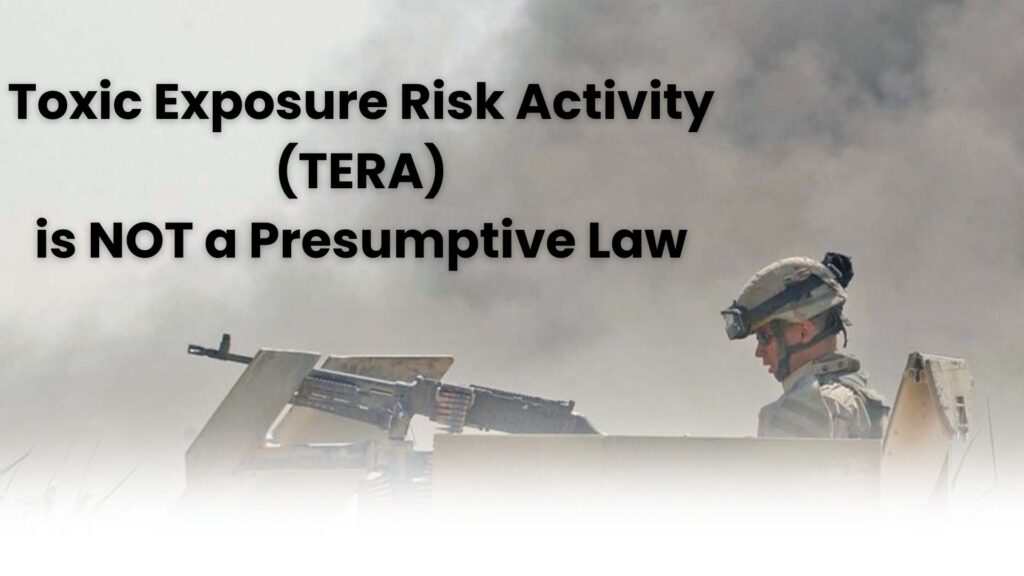
TERA is not presumptive, but it’s important. And confusing. Even some raters get confused here.
TERA regulations, under 38 USC 1168, are part of the PACT Act. It directs VA to consider direct service connection for disabilities not on the presumptive list, if they may be linked to toxic exposures.
Again, this is not a presumptive law. If anyone ever tells you to file a claim based on TERA presumptive conditions, that’s a sign that they have no idea what they’re talking about.
It may help to think of TERA regulations as a completely separate regulation, even though it also falls under the PACT Act.
Consideration of service-connection based on toxic exposure risk activity (TERA) is NOT the same as the presumption of toxic exposure based on burn pits and other toxins (BPOT). The presumption of toxic exposure under 38 USC 1119, is considered a type of TERA, but only for NON-PRESUMPTIVE disabilities. TERA itself is NOT a presumptive law.
So, if you have service in a qualifying location, VA will presume exposure. If you are claiming a presumptive disability, then you will be presumptively service-connected. If you are claiming a non-presumptive disability, then VA will request a medical opinion and consider direct service connection to toxic exposure.
Basically, what this law does, is that it says that if you served in a qualifying area, VA automatically concedes exposure to burn pits and fine particulate matter (BPOT). This becomes your “in-service event” for direct service connection.
You may have other kinds of toxic exposure, depending on your MOS and other particulars of your specific service. But, at the most basic level, every Veteran who would otherwise qualify for the above presumptions automatically get a concession of toxic exposure to be used under this regulation.
Again, it’s important to note that this is a SEPARATE regulation, even though it was also introduced under the PACT Act.
- Presumptive laws (38 CFR §3.317 and 38 CFR §3.320 and 38 U.S.C. §1120):
VA automatically assumes the disabilities (discussed above) are caused by service in certain areas or exposures. - Toxic Exposure Risk Activity (TERA) (38 U.S.C. §1168):
VA automatically accepts that you were exposed to toxins, but you still need a doctor’s opinion linking your specific illness to that exposure.
This is important, because sometimes, even some VA raters get confused and think these regulations are the same.
This means that if you are diagnosed with a non-presumptive disability, and you have qualifying service in Southwest Asia, VA must also request a direct medical opinion to determine if your diagnosed non-presumptive disability is caused by exposure to burn pits and other fine particulate matter while serving in Southwest Asia.
Let’s take a diagnosis of gastroesophageal reflux disease (GERD) as an example to understand how presumptive service connection based on Gulf War service and toxic exposure and direct service connection based on toxic exposure risk activity (TERA) work differently.
GERD is NOT a presumptive condition.
- Under 38 CFR §3.317, GERD does not qualify as a functional gastrointestinal disorder (FGID).
- VA classifies GERD as a structural gastrointestinal disease, meaning it can be seen on tests like imaging or endoscopy.
- Because of this, VA specifically states that GERD cannot be presumptively service-connected as an FGID under 38 CFR 3.317.
- GERD is also not listed among the presumptive disabilities added by the PACT Act under 38 USC 1119.
Unfortunately, some VA raters stop here and deny the claim, completely ignoring consideration of direct SC under TERA regulations. So, it’s best if you are aware so you can file a request for a Higher Level Review or submit a supplemental claim.Complete list of recognized Gulf War and Southwest Asia locations for Presumptive Conditions
What VA must do under TERA regulations:
If you have qualifying service in Southwest Asia, VA automatically concedes that you were exposed to burn pits and other fine particulate matter (BPOT) during your service.
Here’s what should happen next:
- VA creates a Toxic Exposure Risk Activity (TERA) Memorandum
- This document goes into your claims file.
- It states that you were exposed to burn pits, fine particulate matter based on your qualifying service (this will also include any other toxic exposures identified in your record)
- VA requests a medical opinion (nexus opinion)
- The examiner reviews the TERA Memorandum and your medical records.
- The examiner must determine whether your GERD is “at least as likely as not” caused by your toxic exposure.
- If the medical opinion supports that link, VA will grant service connection on a direct basis under 38 U.S.C. §1168.
This is why this regulation is important. Even though GERD is not presumptive, you may still win your claim through direct service connection if the medical opinion links it to your conceded toxic exposure risk activity (TERA).
RELATED:
Understanding VA benefits covered by the PACT Act
What is Toxic Exposure Risk Activity (TERA)?
Complete list of recognized Gulf War and Southwest Asia locations for Presumptive Conditions

Pingback: Understanding VA Benefits covered by the PACT Act – VetHacker
Pingback: What is Toxic Exposure Risk Activity (TERA)? – VetHacker
Pingback: Service Connected: How to Establish Service Connection – VetHacker