Prostate cancer is one of the most common cancers claimed for service-connection. Some estimates show that over 15,000 Veterans are diagnosed with prostate cancer per year. It is the most frequently diagnosed solid tumor cancer among Veterans according to VA data. Studies show that Veterans are twice as likely to develop prostate cancer vs males who have never served in the military.
Is prostate cancer a presumptive condition?
Primary prostate cancer is a presumptive condition under three circumstances:
- When prostate cancer is diagnosed within a year of discharge
- When prostate cancer is diagnosed in a Veteran with herbicide exposure
- When prostate cancer is diagnosed in a Gulf War Veteran with qualifying Southwest Asia service
For Veterans who do not fall under the above circumstances, prostate cancer will have to be established on some other basis, such as on a direct basis; on a secondary basis or based on toxic exposure risk activity (TERA).
If prostate cancer is not a primary cancer, meaning it metastasized from a cancer in another part of the body, then it may not be service-connected on a presumptive basis under these laws.
1. Prostate cancer diagnosed within a year of discharge
When certain chronic disabilities are diagnosed within a year of discharge they may be presumptively service-connected even when the evidence does not show that they began in service.
Malignant conditions or cancers are among the disabilities considered presumptive under this law (38 CFR 3.309(a))
The only caveat under this law is that the disability must have “manifested to a compensable degree” within a year of discharge.
This means that in order for the disability to be presumptively service-connected under this law, the disability must have shown symptoms serious enough to warrant at least a 10 percent evaluation under VA’s Schedule of Rating Disabilities (VASRD).
For prostate cancer, that means it would have to have been active within a year of discharge (100% evaluation) or if it is an inactive cancer, then it must have residuals or other symptoms that can be rated at least 10% under other rating criteria, such as urinary frequency or voiding dysfunction requiring use of absorbent materials.
2. Prostate cancer in Veterans exposed to herbicides such as Agent Orange
Prostate cancer is among the disabilities presumed to be caused by exposure to herbicides such as Agent Orange, based on service in the Republic of Vietnam and several other locations, such as Thailand and Guam.
Similar to the law above, this law (38 CFR 3.309(e)) requires that the prostate cancer have symptoms serious enough to warrant at least a 10 percent evaluation under VA’s Schedule of Rating Disabilities.
However, unlike the presumptive law above, this law does not require that prostate cancer be shown to have manifested within a year of discharge. This law does not impose any time limits. So, if you were exposed to herbicides in service and develop prostate cancer (and can be rated at least 10%) at any time after discharge, you can be presumptively service-connected under this law.
Under this law, prostate cancer became a presumptive disability on January 1, 1996.
3. Prostate cancer in Gulf War Veterans exposed to burn pits and other toxins (BPOT)
Introduced as part of the PACT Act, prostate cancer is included under the definition of “reproductive cancers” that are presumed to be caused by qualifying service in the Gulf War under this law. (38 USC 1120)
Unlike the presumptive laws above, this law does not require that prostate cancer have manifested to compensable levels before service connection can be granted. Presumptive service-connection can be established at 0% under this law.
Similar to the presumptive law based on herbicide exposure above, there is also no time limit for this presumption. If prostate cancer develops at any time after discharge and you have qualifying Gulf War service, you will qualify for the presumption.
Under this law, prostate cancer became a presumptive disability effective August 10, 2022.
What medical evidence does the VA require to establish a diagnosis of prostate cancer?
Under current VA guidelines, an initial diagnosis of prostate cancer can only be established via a biopsy.
An initial diagnosis based on elevated PSA (prostate-specific antigen) is not considered a definitive diagnosis by VA.
However, in instances where prostate cancer was initially diagnosed based on biopsy and was subsequently treated with radical prostatectomy, but the cancer has recurred, then a diagnosis of recurrence based on elevated PSA levels, in conjunction with other symptoms and other clinical findings will be accepted by VA.
For example, if a Veteran developed prostate cancer in 2009, but only filed a claim in 2025, showing recurrence of prostate cancer, then biopsy evidence from 2009 is sufficient to establish the diagnosis, even if a biopsy was not used to establish recurrent in 2025.
How to get a VA examination for prostate cancer?
In instances where VA is establishing service-connection on a presumptive basis for active cancer, you may not be asked to do an examination at the start.
If there is sufficient medical evidence in your file to show that prostate cancer has been diagnosed via a biopsy and that it is currently active, VA can automatically award presumptive service-connection (if you meet one of the presumptions described above) and grant a 100 percent rating. In some instances however, VA is obligated to schedule you for a mandatory review examination six months after your treatment ends.
There may be instances where the evidence is unclear on whether prostate cancer is currently active or in-remission. In this instance, the VA may schedule an examination to determine if the prostate cancer can be considered medically active, or if it is inactive, to determine if any residuals are present.
What VA cannot do is schedule you for a biopsy to confirm a diagnosis of prostate cancer. VA cannot schedule you for an exam as part of the claims process.
On the other hand, a biopsy as part of your regular healthcare under VA (i.e. the VA hospitals or clinics) is a separate thing altogether.
The reason VA cannot schedule you for a biopsy as part of the claims process is that it is considered an invasive procedure. Any procedures that require you to be sedated and/or undergo an invasive procedure is considered outside the scope of the VA claims process. You have to obtain these kinds of procedures from your private doctor.
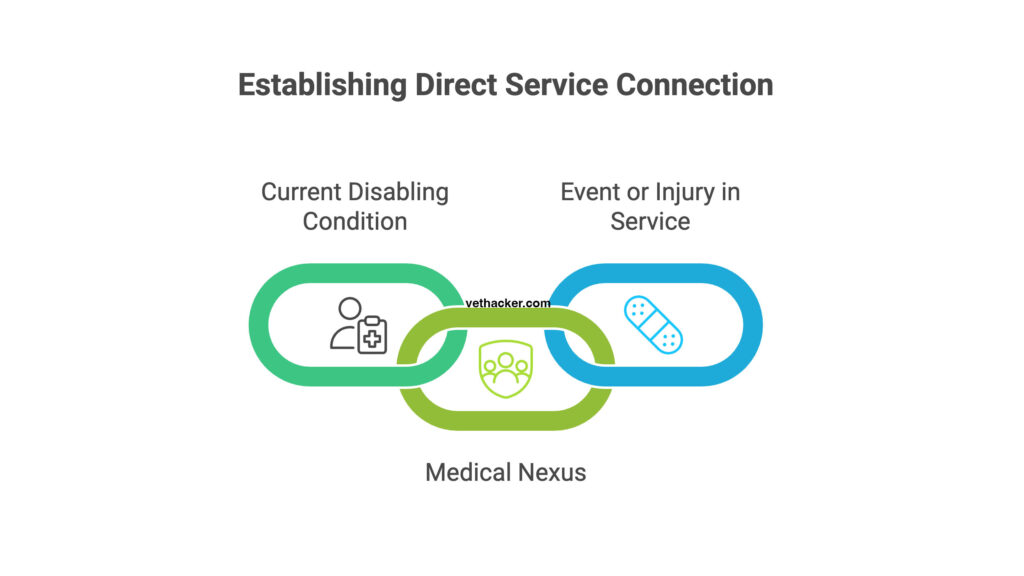
IF, however, service connection on a presumptive basis is not being considered (because none of the criteria above applies), then you will need to show that all three element required for VA to obtain an exam has been met.
- Evidence of a current disability
- An event, injury or disease in service
- An indication that the current disability may be associated with the event, injury or disease in service
These are the three elements that VA requires before they can schedule you for an examination and to request a medical opinion. Typically, for most other disabilities, the first element can be met by evidence of current symptoms. For example, a Veteran can say they have painful urination, or a sudden increase in urinary frequency and that would be sufficient to show evidence of a current disability for purposes of request an examination. However, in the case of prostate cancer, the VA has clarified that evidence of symptoms are not sufficient to meet the first element. As explained above, this can only be satisfied by evidence of a diagnosis based on biopsy.
How does the VA rate prostate cancer?
VA ratings are based on whether the cancer is considered active or in-remission (inactive).
100 percent rating evaluation for prostate cancer (Permanent or temporary)
If prostate cancer is considered active or is currently undergoing treatment, then a 100 percent evaluation is assigned.
This 100 percent evaluation is typically temporary, and is assigned for six months following end of treatment. The VA is then required, by law, to call you in for a “review examination” at the end of six months.
For example, if prostate cancer is treated by radical prostatectomy (removal of prostate), then the 100 percent evaluation is typically assigned for six months after the surgery. At the end of those six months, you will be required to attend a mandatory review examination, unless there is other evidence that the cancer is still active or that it has worsened.
If, however, the evidence shows advanced cancer or that treatment is not curative, then the VA may assign a permanent 100 percent evaluation.
Some of the evidence to indicate that a condition is not expected to improve, include:
- metastases of the cancer (i.e. evidence that the cancer has spread to other parts of the body)
- watchful waiting treatment for active cancer
- resistance to most forms of treatment
- an indication that the condition is terminal
- a prescription for hospice care
VA ratings for residuals of prostate cancer (inactive cancer)
If the evidence shows that the cancer is inactive or in-remission, then VA evaluates the prostate cancer based on residuals. If there are no residuals, then a 0% evaluation is assigned.
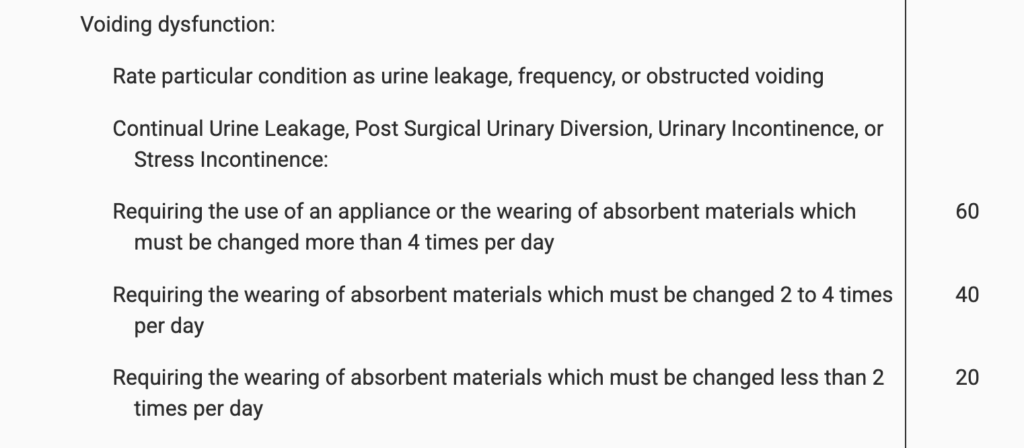
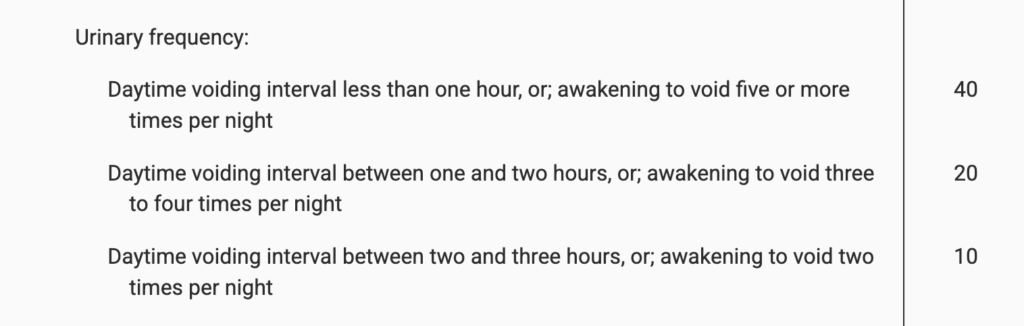
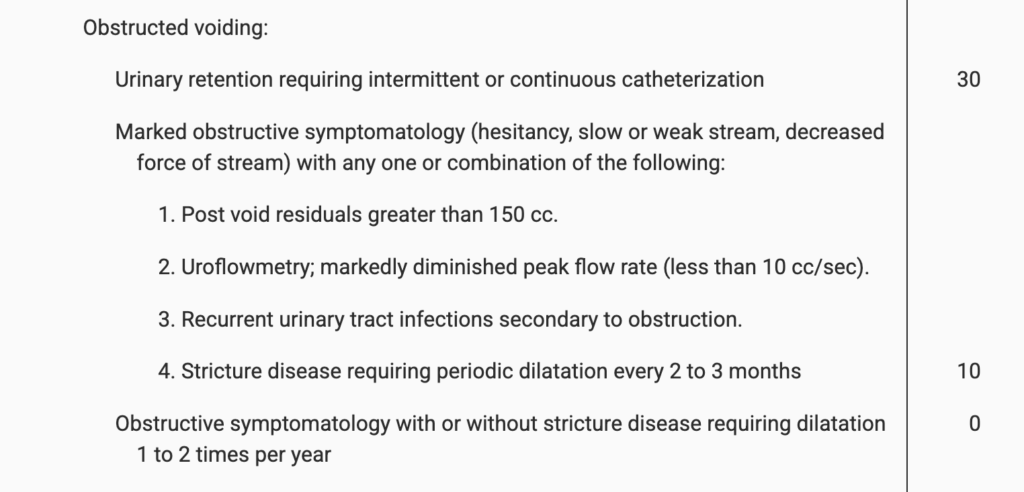
Residuals are typically evaluated based on either voiding dysfunction, urinary frequency or obstructive voiding.
Here is the VA rating criteria for voiding dysfunction:
Here is the VA rating criteria for urinary frequency:
Here is the VA rating criteria for obstructed voiding:
Other residuals such as erectile dysfunction and surgical scars will also be evaluated separately.
One of the more common mistakes is the assumption that service connection for erectile dysfunction is automatic when prostate cancer has been treated with radical prostatectomy (removal of prostate). This is inaccurate. It is actually Special Monthly Compensation (SMC) due to loss of use that is automatically granted by VA. Current VA guidelines state that VA is to automatically grant SMC based on loss of use of a creative organ (SMC K) when evidence shows that prostate cancer has been treated with radical prostatectomy.
SMC K due to loss of use of a creative organ is typically associated with findings of erectile dysfunction, so perhaps this is where the confusion arises. But, VA has clarified that the question of whether there is erectile dysfunction as a result of prostate cancer or as a result of treatment for prostate cancer is a separate medical determination, and erectile dysfunction is not automatically assumed in claims for prostate cancer. However, VA is required to grant SMC K following radical prostatectomy, regardless of whether erectile dysfunction is shown or not.