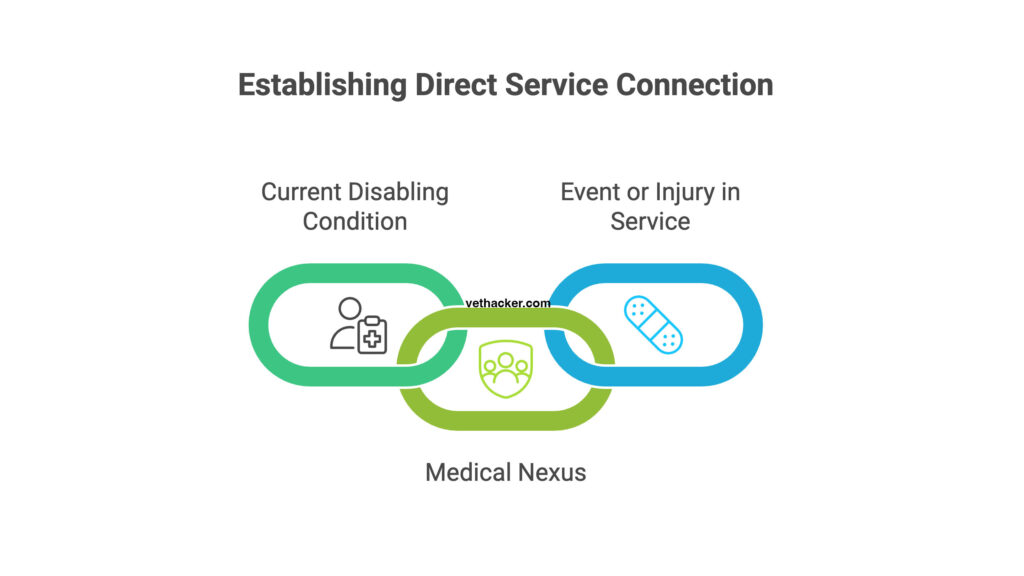
Headaches and migraines are one of the most commonly service-connected disabilities, but, it’s also one of the most confusing. I receive a lot of questions from Veterans on how and why they received they rating they have. So, here, I’m going to breakdown exactly how VA evaluates headaches.
The term “headaches” generally includes diagnoses of headaches; migraines; tension headaches; ocular migraines and so on. Even headaches that are found to be symptoms of an undiagnosed illness, are evaluated this way. The only exception would be purely subjective headache symptoms (meaning, they are not separately diagnosed) that are found to be subjective symptoms of TBI or to be caused by attacks of sinusitis. However, if headaches caused by TBI or sinusitis are diagnosed, then they are also evaluated this way.
Headaches are currently evaluated under diagnostic code 8100 of 38 CFR 4.124a, the VA Schedule of Rating Disabilities for Neurological Conditions and Convulsive Disorders.
VA Criteria for Headache Evaluations
Okay, first let’s take a look at the rating criteria straight from the Code of Federal Regulations (CFR):
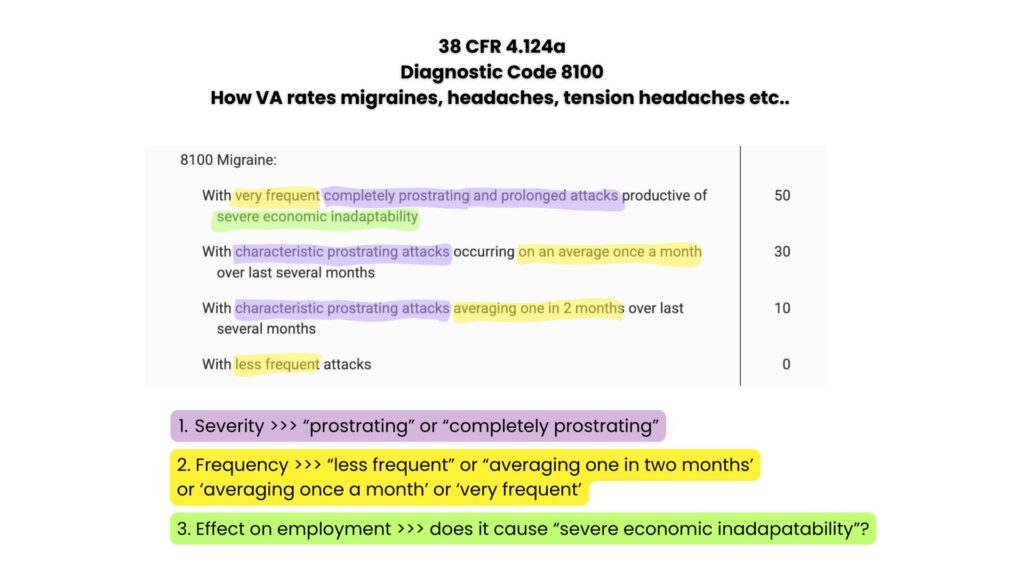
Okay, now pay attention to the colorful highlights.
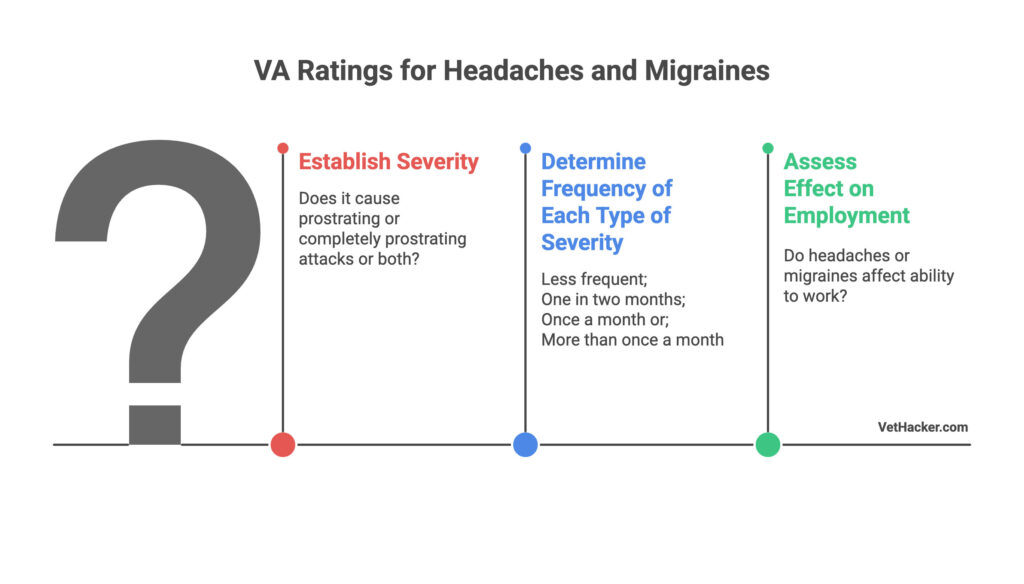
VA rates headaches and migraines based on severity, frequency and whether it affects employment.
Pay attention to the highlights, hopefully this will help break it down. Look at purple (severity) first, then yellow (frequency) second, then green (effect on employment) last.
A common mistake when reviewing examinations and medical evidence is that a lot of people jump straight to the frequency of migraines.
But, before you look at the frequency, you must first establish severity.
How VA looks at severity of headaches
VA clearly defines severity of headaches and migraines as either prostrating or completely prostrating.
Here is how VA’s M21-1 manual defines them:
- Prostrating, means headaches or migraines “causing extreme exhaustion, powerlessness, debilitation or incapacitation with substantial inability to engage in ordinary activities.”
- Completely prostrating, means headaches or migraines causing “extreme exhaustion or powerlessness with essentially total inability to engage in ordinary activities.”
Once you’ve identified what the severity is, that’s when you look at the frequency. But, its important to note that a Veteran can have both prostrating and completely prostrating headaches. So, VA also looks at the frequency of each type of severity.
Sample Disability Benefits Questionnaire (DBQ)
Let’s take a look at a sample Disability Benefits Questionnaire (DBQ) from a VA examiner:
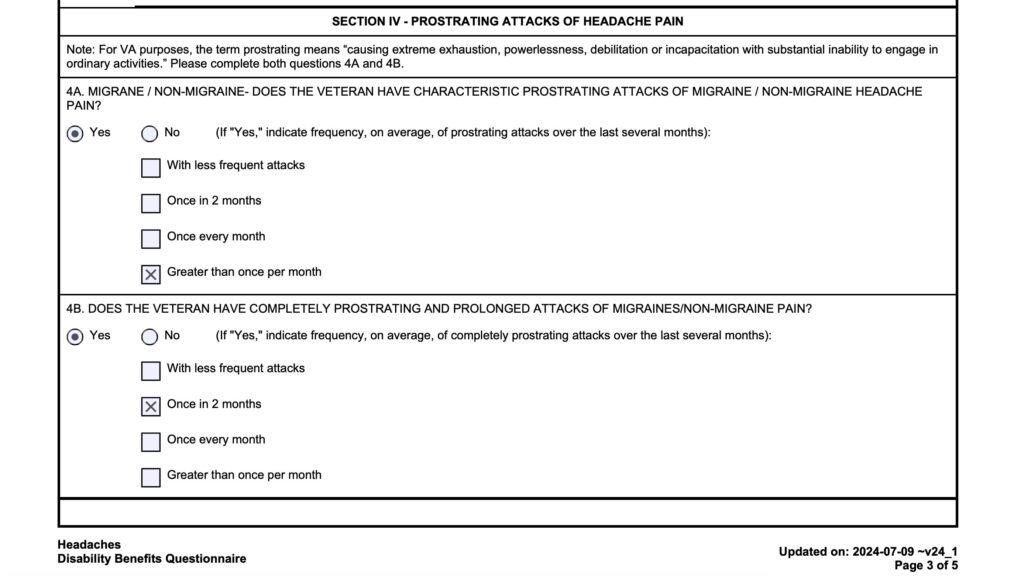
Assuming there were no other evidence on file, what evaluation do you think would be assigned here?
A lot of people zero in on how often the headaches happen (frequency). For example, the part showing that headaches occur “greater than once per month” and assume that they qualify for a 50% evaluation. That’s not correct.
If this DBQ were the only evidence on file, the VA would assign a 30% evaluation in this example.
Let’s break it down.
Step 1: Look at severity first
First, let’s look at severity. Question 4A shows that this Veteran has prostrating headaches. Question 4B shows that this Veteran has completely prostrating headaches.
Second, let’s look at the severity of each. Question 4A shows that prostrating headaches occur greater than once per month. Question 4B shows that completely prostrating headaches occur once in 2 months.
Now, let’s go back and look at the rating schedule in the image above and see where the severity and frequency noted in the DBQ would fall.
Here’s how VA would read this DBQ:
- Question 4A: This Veteran has characteristic prostrating attacks
- Question 4B: This Veteran also has very prostrating attacks
Step 2: Now, look at frequency:
- Question 4A: This Veteran has characteristic prostrating attacks occurring more than once per month
- Question 4B: This Veteran also has very prostrating attacks occurring once in two months
Here’s another way of looking at it:

Step 3: Let’s look at the VA Rating Criteria for a 50% evaluation
Let’s look at the criteria for a 50 percent evaluation under diagnostic code 8100 again:
- With very frequent completely prostrating and prolonged attacks productive of severe economic inadaptability
In plain english, that means that to qualify for a 50 percent rating, that the medical evidence needs to show all of the following:
Severity: Completely prostrating
Frequency: Very frequent (meaning more than once per month)
Effect on Employment: Severe economic inadaptability
Step 4: Let’s match it to the criteria
In this example:
- The severity criteria is met. The Veteran does have completely prostrating attacks of headaches.
- The frequency criteria is not met. The completely prostrating attacks are shown to only happen once in two months. The “greater than once per month” frequency of “prostrating attacks” have no bearing on the criteria for a 50 percent evaluation because a 50 percent evaluation requires a severity of “completely prostrating attacks” and not just “prostrating attacks”.
- Because of that, VA wouldn’t even need to evaluate whether the headaches cause severe economic inadaptability because the frequency criteria has not been met.
Effects on employment
VA *may* still make a determination on the effect of headaches on employment, as part of a determination of individual unemployability, but that is another topic altogether. We will talk more about the meaning of “economic inadapatability” as it applies to the 50 percent criteria in the section below.
Step 5: Why this DBQ warrants a 30 percent evaluation
Although the Veteran in this example experiences prostrating headache attacks more than once per month, the evidence shows that these are not completely prostrating attacks.
While they occur more than once per month, the rating criteria does not assign a higher evaluation for prostrating attacks occurring more than once per month.
The record reflects that completely prostrating attacks occur only once every two months, which corresponds to the criteria for a 30 percent evaluation.
This is overly simplified, to best illustrate how VA applies the rating schedule. In order to come up with a final evaluation, a VA rater would look at the totality of evidence, including medical evidence from your private doctors, your lay statements and your medical records from VA facilities.
What does “severe economic inadaptability” mean?
This requirement only applies to the rating for a 50 percent evaluation.
VA has clarified that the requirement of “severe economic inadapatability” for a 50 percent evaluation is NOT synonymous with unemployability. VA guidelines state that “severe economic inadaptability” does not mean the Veteran is incapable of any substantially gainful employment. Evidence of work impairment includes, but is not necessarily limited to, the use of sick leave or unpaid absence.
The courts have also established that the phrase “productive of severe economic inadaptability” can mean that the headaches are capable of producing severe economic inadaptability, not necessarily that economic inadaptability already exists.
The other important distinction to understand here is that the determination of whether headaches cause “severe economic inadapatability” is a VA rating determination. It is NOT a medical determination.
The other criteria – severity and frequency – these are medical findings. This is why these questions are specifically listed in VA’s Disability Benefits Questionnaire (DBQ).
Most DBQs, including the Headaches (Migraine) DBQ, also include a question regarding the condition’s functional impact, like the one below:
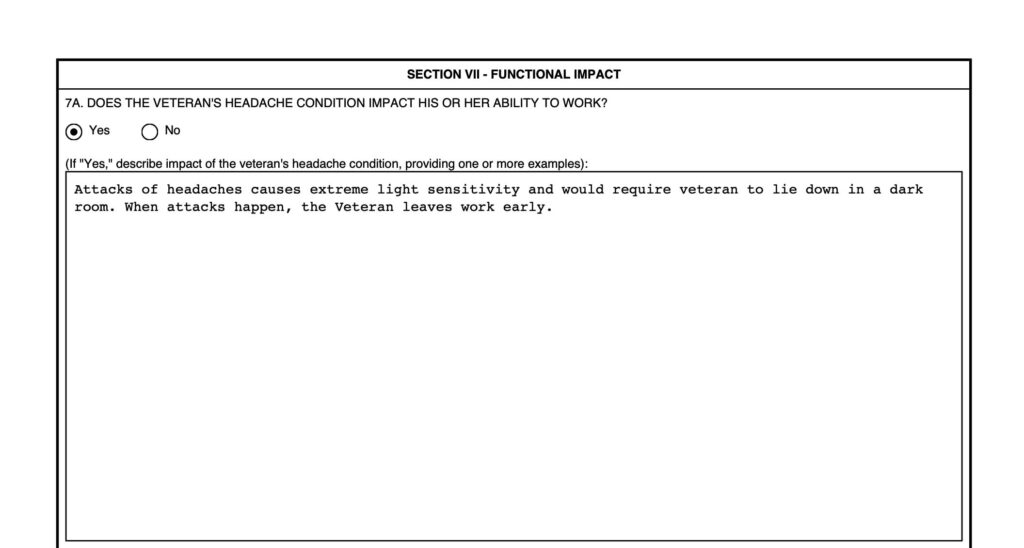
The examiner’s response to this question can help inform the rater’s decision about whether the headaches result in severe economic inadaptability, but it is not the controlling factor.
Assessing functional impact, i.e. how a disability affects a Veteran’s ability to perform physical and mental tasks, is within the medical examiner’s scope. This may include limitations such as how long a Veteran can stand, walk, lift, or concentrate. These are medical judgments about the Veteran’s physical or mental capacity.
However, once we move from functional impact to economic impact, that is, whether the Veteran’s condition causes severe economic inadaptability or affects substantially gainful employment, we move into the domain of VA adjudication, not medicine. This is why this is solely a VA rater’s determination.
So, while a doctor can say a Veteran has to lie down several times a week because of headaches, only the rater decides whether that level of impairment meets VA’s definition of “severe economic inadaptability” for the 50 percent rating (this determination is made in conjunction with all other evidence on file, to include any statements that you have submitted).
It can be a confusing distinction, but it is an important one. Medical professionals describe what a Veteran can or cannot do in functional terms. VA raters then decide how those medical limitations translate into economic impairment under the rating schedule.
What should you submit with your claim?
Since headaches are one of those disabilities that you can’t really test for to determine severity or frequency, it is best if you submit as much relevant medical evidence and lay statements as you can.
These may include migraine logs. This can be in the form of notebooks, or an app like MigraineBuddy.
Medical records showing treatment and medications prescribed can also be useful. Medical records can serve two purposes – they can help establish chronicity of your condition, such as whether you received continuous treatment since service and/or they can help establish severity and frequency of your headaches.
If you’ve ever had an emergency room visit because of headaches, send those in, too.
If you’ve ever been written up at work due to excessive sick leave or absences because of headaches, get a copy of that too and send it in.
Lay statements are also key for ‘subjective’ disabilities like headaches. Describe the severity of your headaches. You may not have time to fully describe them during your VA examination, so it’s always best to send it to VA to add to your file and to bring it with you during your VA examination.
Doctors depend on what Veterans tell them when making medical judgments. These statements or opinions are normally seen by VA as trustworthy unless there’s proof that the history the Veteran gave was false or mistaken.
It’s always best when your personal statements are backed up by medical evidence. When you send a lay statement to VA, they first have to decide if it’s credible, i.e. if what you said is believable. One of the best ways to support your statement is if it matches what’s written in your medical records.